
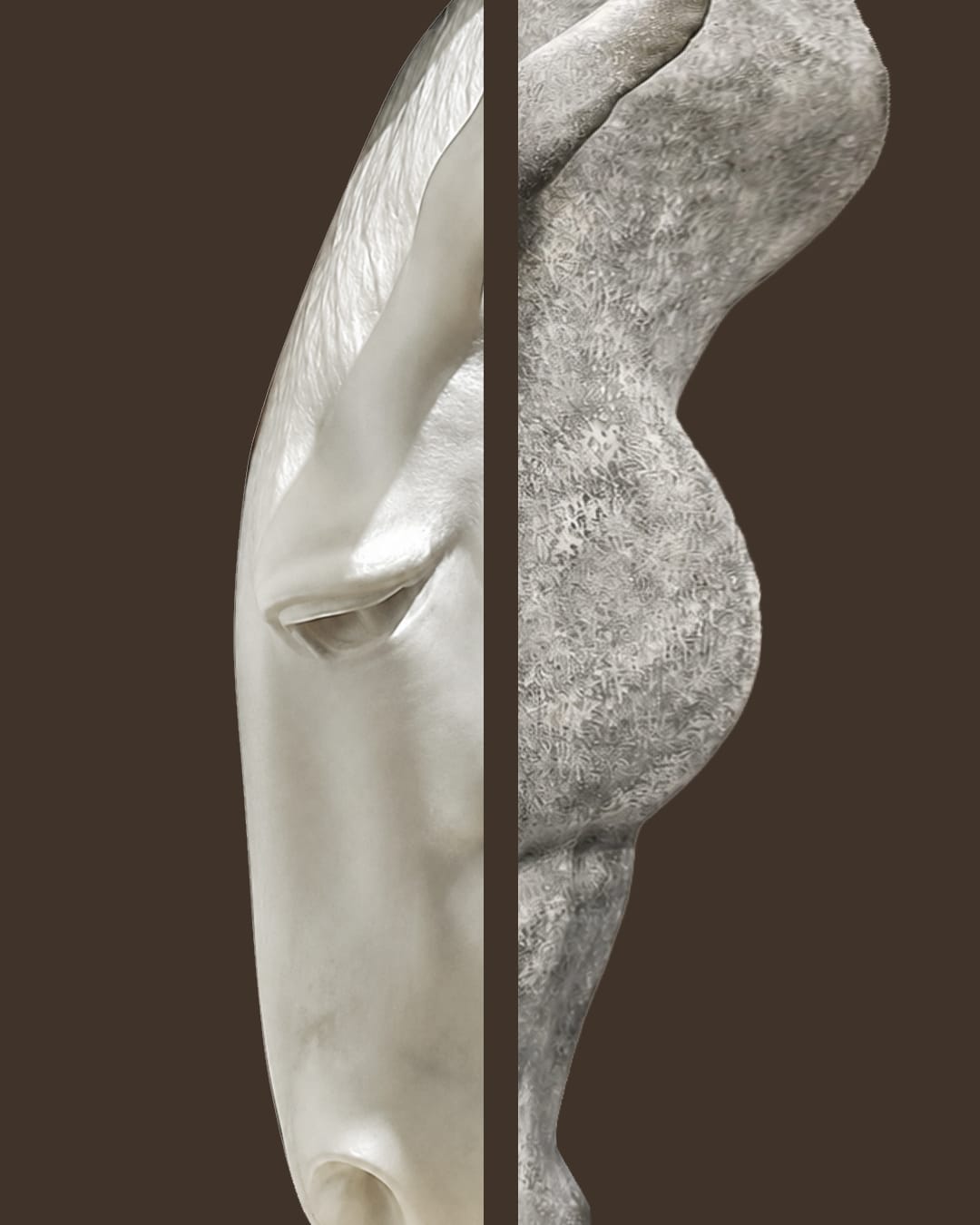
A printed part that looks like a prototype can sink a design review before anyone looks at the design. Soft detail, rough patches and distorted curves make a strong form look unfinished, and no finish fully hides them. Hybrid Horse shows how we avoid that. 3D Vector used SLA 3D printing to make a detailed resin horse head, and On Point Design Studio finished it by hand into an object that reads as stone. Standard lead time at our Mississauga shop is one to three days.
Have a model and a deadline? Request a quote and we will tell you what it takes.
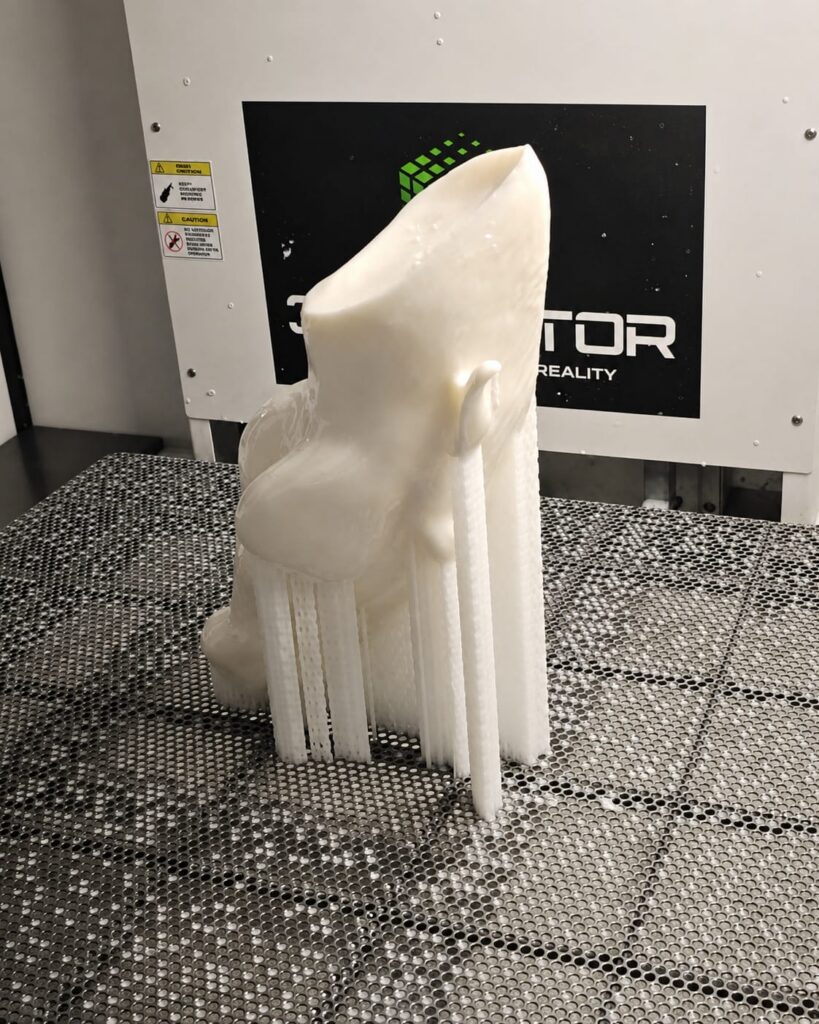
The horse head as it came off the printer, supports still attached.
What we built and who did what
Hybrid Horse started as a digital model. The form is a horse head with long curves, subtle transitions and surface detail that has to hold up under changing light. The geometry came from a licensed third party model. Our job was to turn that file into a physical object someone else could build on.
Small changes in curvature or proportion can change the character of a sculptural form, so the print had to stay faithful to the model. That faithfulness is what made hand finishing possible.
We printed the head in SLA resin and prepared it for finishing. On Point Design Studio took over from there. They led the creative concept and material direction, applied modeling paste by hand, refined the surface, added the colour and completed it with a satin finish. The final piece combines the head with plaster, ebonized red oak and concrete.
It looks like stone. Under the finish, it is still the resin part we printed. That split is the point. We did not design the finish and On Point did not need a print shop. Each side did the work it does best, and the piece came together because the printed part gave the finisher a reliable starting point.
What Hybrid Horse shows about our work
A horse head is a hard test for a printed part. Nothing on it is flat or square. Every area curves into the next, so a small error shows. If a form like that comes out of the machine looking right, simpler parts are rarely a problem.
It also shows how we handle jobs with more than one team involved. We know our part of the work, we do it properly, and then the part goes to the next person in good shape. If you have a studio, painter or fabricator waiting on your print, that is the experience we want to give you.
And it shows the pace we work at. A standard lead time of one to three days means you can plan the next stage around a short, known print time.
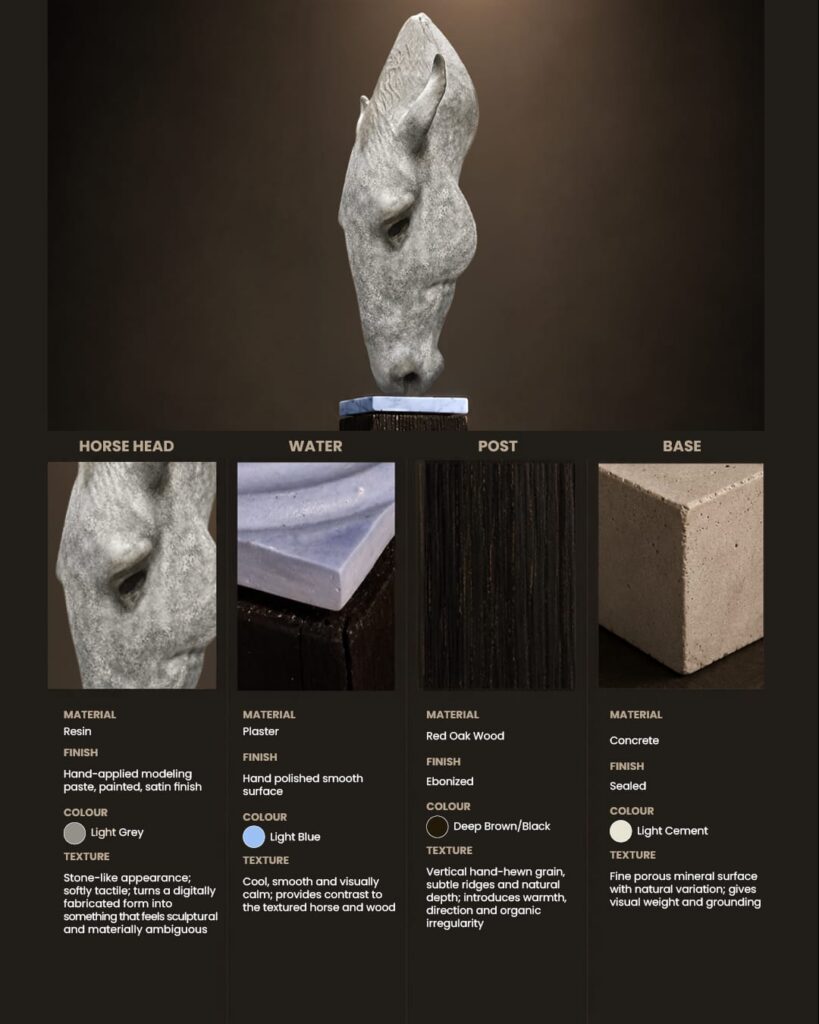
The finished piece and its materials, developed by On Point Design Studio.
Who this kind of work is for
Most people who come to us for SLA have a deadline and a part that has to look right. They are not shopping for a process. They want the part in their hands and ready for the next step.
Our SLA parts gallery shows the range, from film props and architectural models to engineering and medical prototypes and consumer goods. If you work in film or television, our movie and prop industry page explains how we support prop work. You can also browse the full range of projects on our work page.
Design studios, architects, product teams and prop makers send us work like this. What they have in common is a digital file, a date and a need for the part to arrive in a state that suits whoever handles it next.
Why SLA suited this part
SLA builds parts by curing liquid photopolymer resin one layer at a time with light. The vocabulary is set out in the ISO/ASTM 52900 standard for additive manufacturing, and a peer reviewed review of vat photopolymerization explains the process in more depth. For a part like the horse head, it came down to four practical points.
Detail holds
Fine curves and small surface changes come through the print, and on a sculptural form a small shift in proportion changes how the whole object reads.
Surfaces start smooth
That gives whoever finishes the part a better base for paste, paint or coating. Every hour a finisher spends repairing a rough surface is an hour not spent on the finish itself, and on a deadline that adds up.
No tooling is needed
A one-off sculptural part does not justify a mold. You send the file and we print it.
Complex shapes are fine
Undercuts, curves and organic geometry are where SLA does well compared with many other methods.
You can read more about the process on our SLA 3D printing service page.
What else we print this way
The same approach works well beyond sculpture. We print concept and appearance models, design prototypes, scale models, presentation models, custom components and complex decorative forms. Product development teams use these parts to review a design, show it to a client or see how it sits next to other materials. If your project needs a physical version of a digital idea, and needs it soon, this is the kind of work we do.
A printed part also gives your team something real to react to. Clients and colleagues respond differently to an object they can hold than to a render on a screen, and decisions tend to come faster. That is often the real reason people order a model like this before committing to the next stage.
Where SLA is not the right choice
Cured resin is stiffer and more brittle than many plastics, so a part that has to flex, take impact or carry a load may suit another process better. Our services also include FDM, SLS, DMLS and CNC machining, all listed on our 3D printing services page.
If you need several copies, a printed master can feed rubber casting, where a silicone mold replicates the master in rubber. If a surface or dimension needs machined accuracy, CNC machining is also one of our finish levels. Tell us what the part has to do and we will tell you which route fits.
Finish levels
We offer six finish levels, so you can buy the part at the stage that suits your project.
- Strip & Ship. Supports removed and the part sent out as printed. A good fit when you plan to finish it yourself.
- Ready for paint. A prepared surface so a painter can start right away. This suits studios and fabricators who handle their own coating.
- Spray Paint. A sprayed paint finish applied by us.
- Polyurethane Paint. A polyurethane paint finish applied by us.
- CLEAR. A clear finish applied by us.
- CNC Machining. Machined features for surfaces or dimensions that need extra accuracy.
How do you choose? Start from who touches the part next. If it goes straight to a client, a painted or clear finish saves you a step. If a studio will finish it their own way, an earlier level leaves them room to work. If you are unsure, say so when you ask for a quote and we will talk it through.
The finish level is worth settling before the print, not after. It affects how we prepare the part, how long the job takes and what the next team receives. A quick decision at the quoting stage saves a back and forth later.
Not sure which level you need? Send us your model or call 416-477-3525.
How a job with us works
- Send us your file and a short brief through the form, by email or by phone.
- We check the model and the finish level you want, then send a quote.
- We print the part in SLA resin. Standard lead time is one to three days.
- We apply the finish level you chose.
- The part is ready for you or your finishing team.
If anything in the file needs attention, we tell you before printing, not after.
Working with a design studio or finisher
Many parts we print go on to someone else. A design studio, a painter, a model maker or a fabricator takes over and finishes the work. Hybrid Horse went that way, and it is a common path for sculptural and presentation pieces.
A few things make that handoff smoother. Tell us who will finish the part and how, whether that is paste, paint, plaster or another coating. Tell us which surfaces matter most so we can plan around them. Tell us what condition the part should arrive in, for example with supports removed or ready for paint. And tell us the date the next team needs it, so the print fits their schedule.
You do not need to know the technical vocabulary. Describe the result you want and we will work backward from it.
Planning your timeline
Standard lead time is one to three days, and that covers our part of the job. Your own schedule has more steps than ours. Count the days your finisher needs, add time for review and any changes, and work back from your delivery date. Tell us that date when you ask for a quote and we will say plainly whether it works.
If the date is tight, say so at the start. A short note about the deadline costs you nothing and helps us plan the print around it. We would rather know on day one than on day three.
What to send for a quote
The more you tell us up front, the faster we can quote. This is what helps.
- Your model file, STL or OBJ for sculptural forms and STEP for CAD solids
- The finished size
- How many parts you need
- The finish level you want
- Who finishes the part next, and how
- Your deadline
- Any surface that should not be sanded or touched
Send it through the contact page, email [email protected] or call 416-477-3525. We are at 1455 Britannia Rd E in Mississauga.
Questions we hear
How long does SLA printing take? Standard lead time is one to three days. Part size and finish level affect timing, so we confirm it when we quote.
Can you print a single sculptural part? Yes. SLA needs no tooling, so one piece is practical. Hybrid Horse is one example.
Do you finish parts or only print them? We do both. Our finish levels run from Strip & Ship to CNC Machining. Hybrid Horse was finished by On Point Design Studio, and we are happy to work that way again.
Can I get copies of a printed part? If you need multiple copies, ask us about rubber casting from a printed master. We will tell you whether it makes sense for your quantity.
Do you only offer SLA? No. Our services also include FDM, SLS, DMLS, CNC machining and rubber casting, so we can point you to the process that suits the part.
What if I do not have a file? Ask us about 3D scanning and reverse engineering. Tell us what you have and what you need and we will suggest a starting point.
What if my file has problems? We check the model before printing and tell you if something needs attention.
Where are you based? 1455 Britannia Rd E, Mississauga, Ontario.
Request a quote for SLA 3D printing in Mississauga
If you have a complex or sculptural part, send us the model. Request a quote, email [email protected] or call 416-477-3525. We will come back with a quote and a clear lead time.
Project Credits: Hybrid Horse was developed as a collaborative fabrication and material exploration project. Horse-head geometry was produced from a licensed third-party 3D model based on the Still Water horse form associated with sculptor Nic Fiddian-Green. 3D Vector provided SLA 3D printing. On Point Design Studio developed the project concept, CMF direction, surface finishing and final material expression.